How to Choose a Bouquet When You Don't Know Their Taste: A Method That Doesn't Involve Guessing
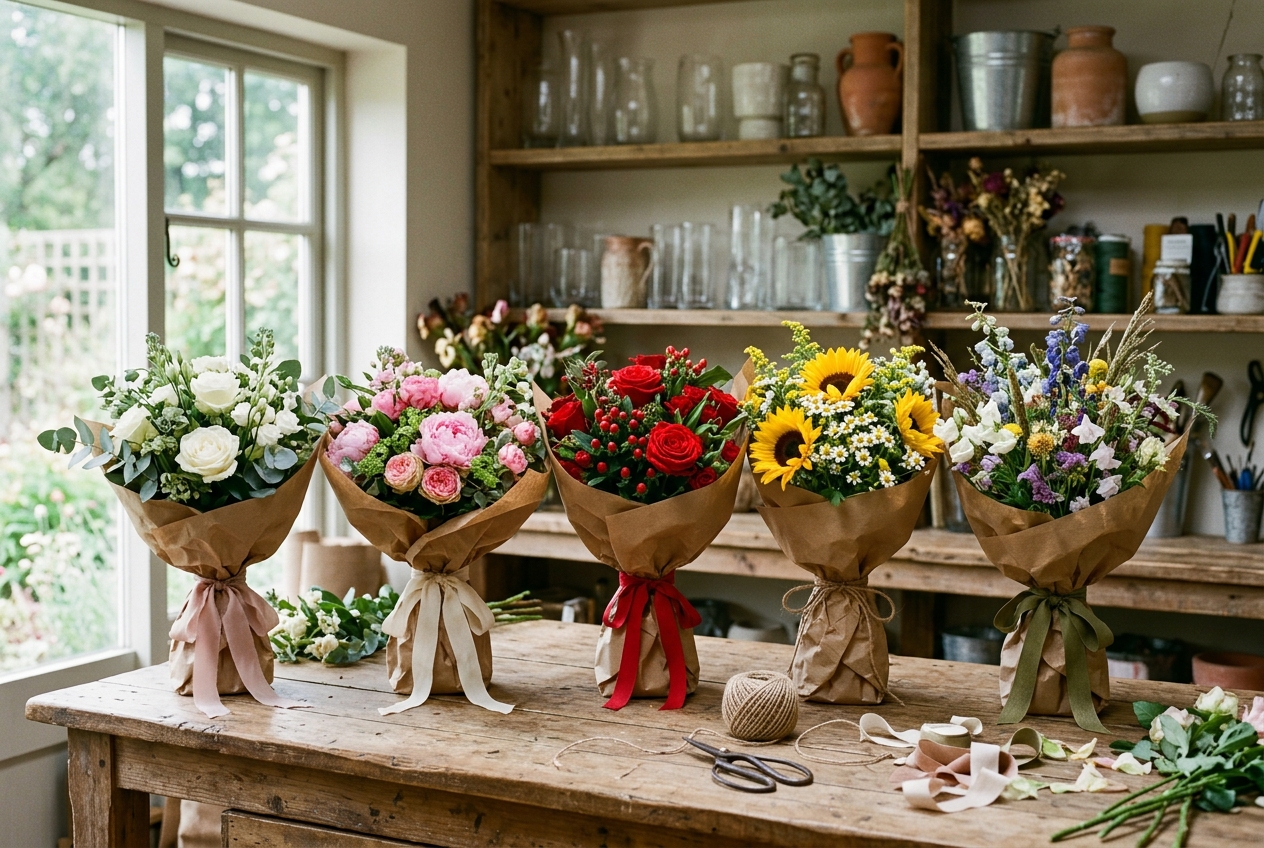
Short answer if you're in a hurry: go for a calm palette (cream, dusty pink, white with greenery), one or two types of flowers rather than ten, a medium size, no strong scent and nothing exotic. It's almost impossible to dislike a bouquet like that — and we'll deal with the "almost" below.
Now the long answer, because "I need to give flowers and I have no idea what she likes" comes up far more often than you'd think. A new colleague. A friend's mother. A teacher. A woman you've met twice. A future mother-in-law you're still addressing rather formally. A business partner from another country. Every day someone messages us with more or less the same words: "Help, I don't know her taste."
Over the years YUCCA Flowers florists have worked in a lot of cities — Istanbul to Dubai, Barcelona to Bangkok — and we've settled on a simple way not to miss in exactly this situation. Here it is.
First, admit it: you know more than you think
"I know nothing about her" is almost always untrue. You know her age, at least roughly. You know which city she lives in. You know the occasion — or you know there isn't one. You've probably seen her clothes, her phone, her desk, her car, her social media. That's already plenty.
We ask clients five questions. None of them is about flowers.
- How old is she — roughly? Twenty-five and sixty-five react differently to the same peonies.
- Who is she to you? Colleague, relative, third date, boss, family friend. This decides not the flowers but the distance of the bouquet.
- Where will she receive it? At home, at the office, in a restaurant, at a hotel, at a train station. This decides the form — cut stems, box or basket.
- How does she dress? Bold or quiet? Lots of jewellery or none? Practical or dressed-up?
- What do you want to say? "Thank you", "congratulations", "I like you", "I'm sorry", "I'm here for you." Each one is a different bouquet.
If you can answer even three of those, you're no longer choosing blind.
The universal rules of a "safe" bouquet
There are bouquets that almost nobody reacts to negatively. They share a few traits.
A calm palette. Cream, white, dusty pink, peach, soft lavender, plenty of greenery. Not bright orange, not neon fuchsia, not black-burgundy — those are colours people either adore or can't stand, and you don't know which half she's in.
Few types of flowers. One or two, three at most. A bouquet of twelve different flowers looks like "we grabbed whatever was there." A bouquet of roses and eucalyptus looks like a decision.
Medium size. Not a single stem (can read as "he was being cheap"), not an armful up to the ceiling (can embarrass her, especially if you're not close). A bouquet she can comfortably carry in one hand is the sweet spot.
No strong scent. Lilies, hyacinths and some freesias smell so intensely that after an hour indoors you want to open a window. Plenty of people have allergies you know nothing about. Roses, peonies, hydrangeas, ranunculus and lisianthus are quiet or scentless.
Nothing exotic. Protea, anthurium, bird of paradise, black calla — striking, but they're acquired-taste flowers. If you don't know whether she has acquired the taste, don't gamble.
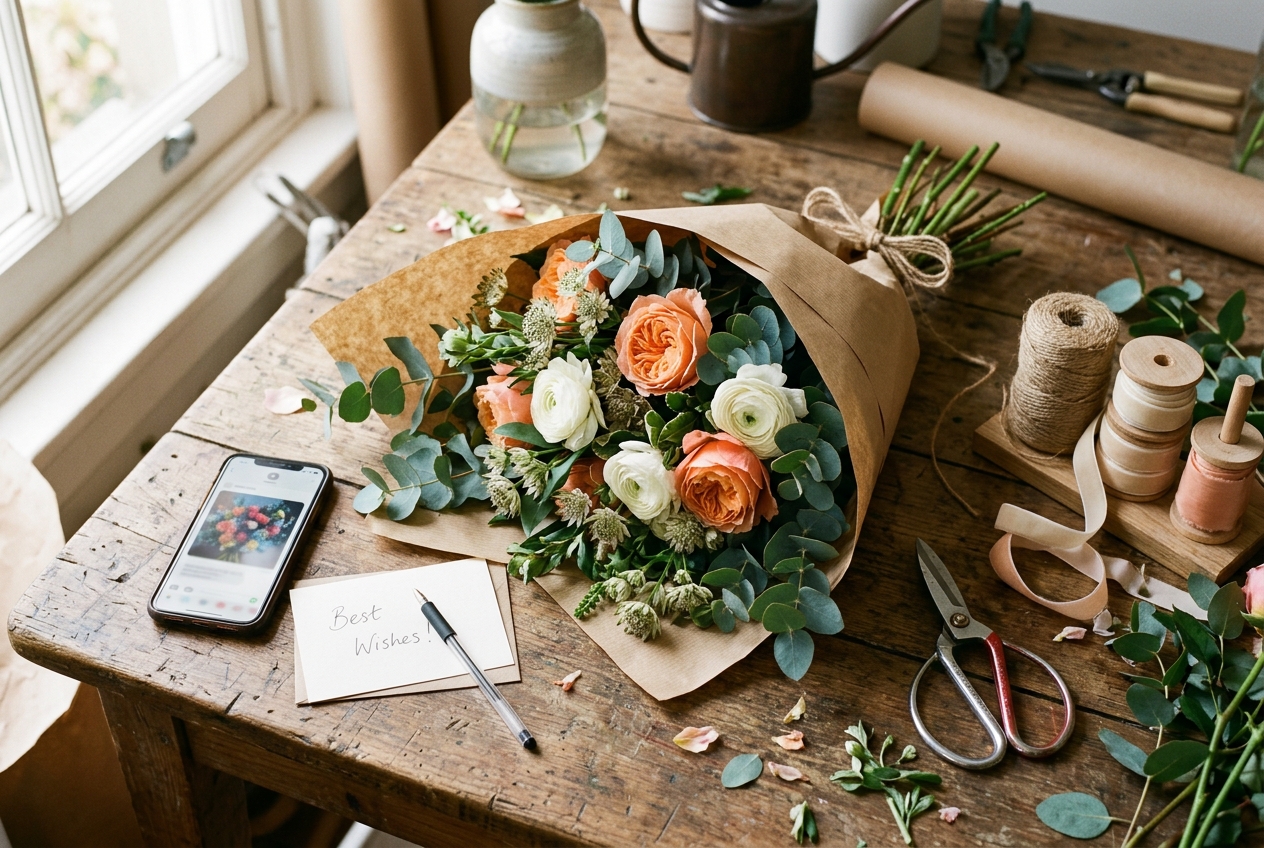
Neat wrapping. Kraft paper, matte film, a ribbon without glitter. No mesh, no plastic printed with "I love you", no artificial butterflies. The wrapping should never get more attention than the flowers.
Put all that together and you have the "neutral" bouquet. It won't trigger "how did you know?!", but it will get an honest "that's beautiful." And for someone whose taste you don't know, that is the ceiling.
Choosing by type — when you want to get closer
The neutral option is the baseline. But if you've seen anything at all, you can aim more precisely. These are the types we've come to recognise over years of conversations with clients. They're rough, but they work surprisingly often.
"The minimalist"
Dresses in black, grey, beige. Clean desk, phone without a case, not a single unnecessary object. For her — monochrome: white roses, white ranunculus or one large hydrangea head. Zero clutter. The less wrapping the better.
"The romantic"
Dresses, curls, candles in her stories, loves cafés with flowers on the tables. Peonies. Out of season — garden roses, spray roses, lisianthus. A powdery palette, an airy shape, a satin ribbon.
"The pragmatist"
Says "why flowers, they'll just die." Don't argue. For her — an arrangement in a box or a basket with floral foam: it lasts two weeks, needs no vase and no care. Or a potted plant, if that fits. She'll appreciate that you thought about her convenience.
"The bold one"
Red lipstick, coloured nails, laughs loudly, always at least one bright element in her outfit. She can have what the others can't: coral roses, orange ranunculus, fuchsia, contrasting combinations. She'd find the neutral bouquet boring.
"The classic"
Grown-up, elegant, good posture, an expensive but understated bag. Roses. Large, a single variety, cream or soft pink, an odd number, formal wrapping. No experiments — she won't appreciate them, but she'll always appreciate roses.
"Can't tell"
Then — the "safe" bouquet from the previous section. It's honest and it works.
The occasion changes everything
The same woman expects different things on her birthday and at a relative's funeral. A few pointers:
- Birthday, milestone — you can go brighter and bigger than usual. It's the one day when "a lot" doesn't look like too much.
- Gratitude (a doctor, a teacher, a colleague) — medium size, calm palette, ideally in a box so it can sit on a desk without a vase.
- Early dates — more modest than you feel like. Three to five stems or a small dense bouquet. A big bouquet on the second date is pressure.
- Apology — soft light flowers, absolutely not red roses. And a note in your own words.
- Housewarming, a new baby — something that needs no care: a basket, a box, a potted plant.
- Condolences — white or pastel, restrained, no glittery ribbon. Some countries have their own rules (more below).
We covered this in more detail in "Flowers by Occasion".
The recipient's country — the thing everyone forgets
A person's taste is also the culture they live in. A few things that can turn a good bouquet into an awkward moment:
- Even numbers. In Russia, Ukraine, Poland, the Baltics and the Caucasus, an even number of stems is tied to mourning. In Western Europe, the US, the UAE and Asia there's no such rule — a dozen roses is perfectly normal. In doubt, go odd; it offends nobody. More in "How Many Roses to Give".
- Chrysanthemums. In France, Italy, Poland and Spain they're a cemetery flower. In Japan, by contrast, an imperial symbol. If the recipient is in Europe, better skip them.
- White. Across most of Asia white flowers are associated with loss. For Bangkok, Ho Chi Minh City or Colombo we suggest pink or peach instead of white. In Europe and the Middle East white is neutral and appropriate.
- Yellow. In Russia it was long read as "a sign of parting", though younger generations no longer think about it. In Turkey and Spain yellow is simply sunny.
- Lilies. In the UK and parts of Europe they also carry a funeral note, plus that heavy scent.
If you're ordering to another country, tell the florist. We work in dozens of cities and flag these things ourselves.
What to do when you have no information at all
It happens: you know a name and an address, nothing more. Three tools still left:
Ask a mutual acquaintance. One message — "hey, what flowers does Marina like?" — solves it in a minute. We're amazed how rarely people do this.
Look at her social media. Not for flowers — for the overall picture. Which colours dominate her feed? Lots of nature photos? A dark or a light aesthetic? Five minutes and one of the types above becomes obvious.
Make the choice deliberately neutral and say so. A note like "I didn't know what you like, so I chose what I like — hope it works for you too" sounds honest and disarming. It's far better than pretending you guessed.
Mistakes we see every single day
- Compensating ignorance with size. "Don't know what — I'll get a big one." A big miss is worse than a small hit.
- Mixing everything. The florist suggests roses — "and can we add lilies, gerberas and those blue ones?" You end up with a salad.
- Chasing novelty. Dyed roses, glitter on the petals, "rainbow" flowers. Some people love them; most don't.
- Forgetting where it'll be handed over. A huge cut bouquet delivered to an office with no vase will sit on a windowsill until evening and wilt.
- Skipping the note. A bouquet without words is just flowers. A bouquet with two lines is a gift.
How it works with us
If after all this you're still unsure — message us on WhatsApp and simply answer the five questions from the start of this article. A florist will suggest two or three options from your city's catalog, explain why, assemble the bouquet and send you a photo before dispatch. If anything's off, we redo it before the courier leaves.
Catalogs are open in dozens of cities: Istanbul, Dubai, Barcelona, Krakow, Phuket and more — the full list is on the homepage.
FAQ — choosing a bouquet when you don't know their taste
What counts as a universal bouquet? Cream or dusty-pink roses (eucalyptus optional), peonies in season, or white hydrangea. One or two types of flowers, medium size, calm wrapping, no strong scent.
Which flowers should you definitely not give to someone you barely know? Strongly scented ones (lilies, hyacinths), exotics (protea, anthurium), dyed or glittered flowers, chrysanthemums in Europe, white flowers in Asia, and red roses unless you're in a romantic relationship.
Is a single-variety bouquet better than a mixed one? If you don't know their taste — one or two varieties. A mono-bouquet reads as a deliberate choice; a busy mix reads as an accident.
What size should the bouquet be? Medium: 7–15 stems, or an arrangement she can carry in one hand. A huge bouquet for someone you barely know can embarrass; a single stem can look like economising.
Should I give a potted plant instead of a bouquet? Only if you know for certain the person loves plants and will look after them. Otherwise a boxed or basket arrangement is safer — it lasts long and needs nothing.
What should I write in the note if we barely know each other? Short and specific: what you're thanking or congratulating them for, and your name. One or two lines in your own words beat any pretty quote.
Related reading
- "Flower Meanings — What Each Colour Says"
- "Flowers by Occasion"
- "How Many Roses to Give"
- "Roses or Peonies — Which to Choose"
- "How to Keep a Bouquet Fresh Longer"
YUCCA Flowers — flower delivery in dozens of cities across Turkey, Europe, the UAE and Asia. We'll help you choose a bouquet for someone you barely know: photo before dispatch, delivery from 1 hour, payment from any country.
READER EXCLUSIVE
5% off your first order
Because you came from our blog, enjoy 5% off your first order. Just mention promo code BLOG5 to the florist on WhatsApp.