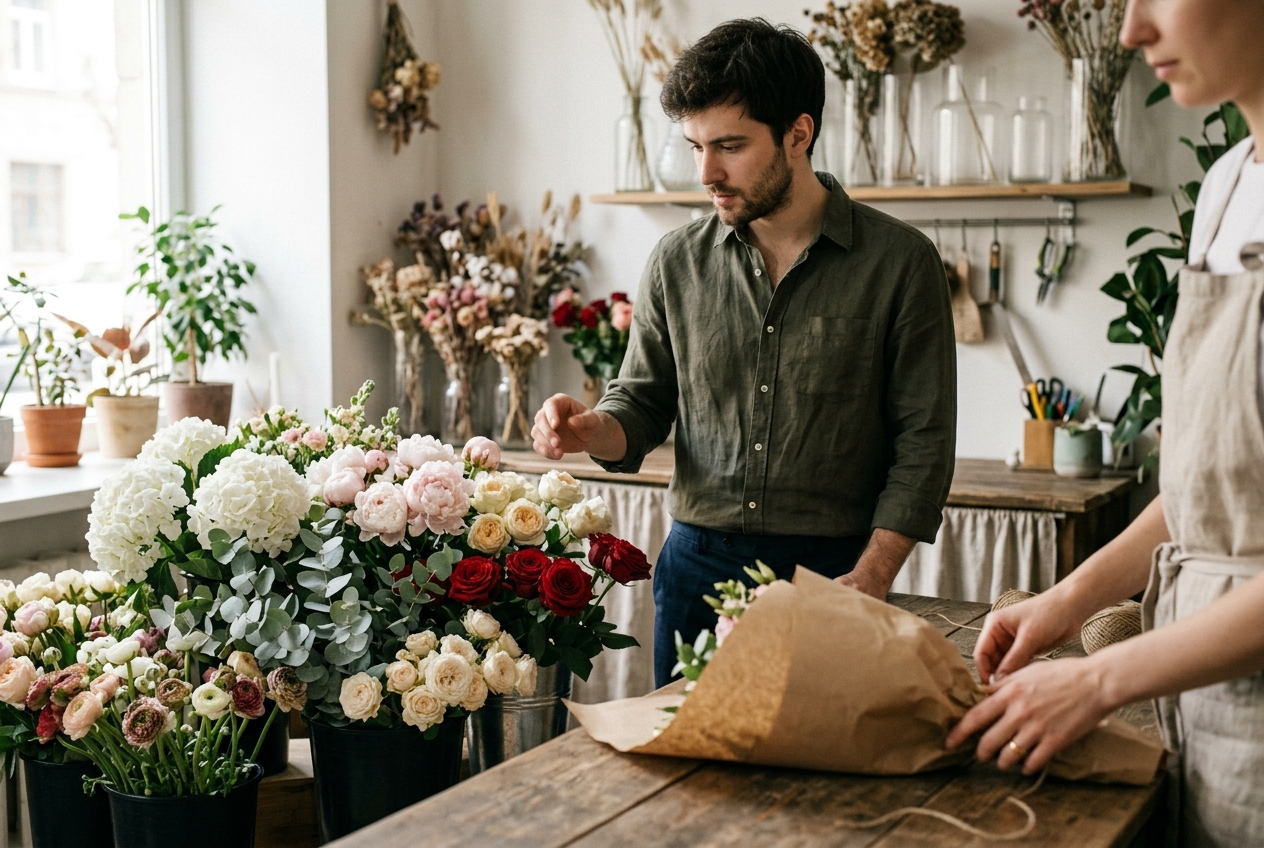
Flower Meanings — What Each Color Says
A bouquet is a message read without words. And the first thing a person registers when they unwrap it is the colour. Before they identify the variety of flower or catch its scent, their brain has already reacted to the palette: red is passion, white is purity, yellow is joy. Colour works faster than the text on a card.
This guide is about the language of colour in floristry. We'll break down what each shade means, the emotions it conveys, who and what occasion it suits — and where it's easy to slip up. At the end we'll gather it all into a simple cheat-sheet so you can choose a bouquet that says exactly what you mean.
Want to pick a bouquet right away — message us on WhatsApp or open any city catalog: Antalya, Istanbul, Mykonos. We'll help match the palette to the occasion.
Why colour matters more than it seems
Colour is emotion read instantly. Psychologists have long known that shades affect perception more strongly than shape or size. Warm colours (red, orange, yellow) read as energy and closeness; cool ones (blue, purple, white) read as calm, respect, distance. So the same rose bouquet in red and in white sends completely different messages, even though the flower is identical.
The second layer is cultural. In some countries white is the colour of weddings, in others of mourning. Yellow in Europe and Turkey means sun and friendship, while in some Slavic traditions it carries a superstition about "separation." Understanding these nuances helps you avoid a misstep, especially if the recipient comes from a different culture.
Red — passion, love, declaration
Red is the most powerful colour in floristry. It's the language of romance with no half-tones: "I love you," "you're the only one." Red roses are the universal symbol of passion, which is why they're given on dates, anniversaries and the day of a declaration.
Who and when: a partner or spouse, for a romantic occasion. Red is rarely used for business or friendly greetings — it sounds too intimate.
Nuance: intensity matters. Bright scarlet is fervent, youthful passion. Deep burgundy is mature, steady feeling (more on burgundy below). If you want to amplify the message with quantity, see the guide "Roses in Mykonos" with the 15/51/101-rose breakdown by occasion, or "Roses in Antalya".
Pink — tenderness, care, affection
Pink is softer and more versatile than red. It speaks of tenderness, gratitude, admiration, a gentle crush — without the pressure red carries. It's the ideal colour for the start of a relationship, for a mother, a friend, a young couple.
Light pink — delicacy, youth, "I like you." Bright pink (fuchsia) — energy, gratitude, recognition.
Pink peonies and roses are the "safest" romantic choice: beautiful, warm and never pushy.
White — purity, respect, a new beginning
White is the colour of sincerity and dignity. It conveys purity of intent, respect, admiration without romantic subtext. That's why white flowers suit both a wedding (a symbol of a new start) and a gesture of deep respect to an elder, as well as a refined minimalist gift.
Who and when: for a wedding, as a mark of respect, for a restrained elegant gesture, for an interior. White lilies, roses, orchids and hydrangeas are the choice of those who value the laconic.
Cultural nuance: in most of Europe and in Turkey white is a positive, festive colour. In some Asian cultures it's associated with mourning — worth considering if the recipient is from there.
Yellow — joy, friendship, optimism
Yellow is sunshine in a bouquet. It conveys joy, warmth, energy and firm friendship. Yellow tulips, sunflowers and gerberas are a great choice for a friend, a colleague, a discharge from hospital, good news, or simply to lift the mood.
Who and when: friends, colleagues, happy events, "just to cheer someone up."
Nuance: in a romantic context, yellow is better mixed with other colours — on its own it reads as friendly rather than loving.
Orange and peach — energy, warmth, gratitude
Orange is drive and confidence, the colour of bright, active people. Peach (its softer version) is warmth, sincerity, modest gratitude. Peach David Austin roses (the Juliet variety, for example) are one of the most sought-after shades for weddings and gentle occasions.
Who and when: orange — for energetic, creative people, for vivid events; peach — for a wedding, an anniversary, a gesture of warm gratitude.
Purple and lilac — admiration, refinement, mystery
Purple is the colour of nobility and admiration, historically linked to luxury. It says: "I admire you," "you're special." Lilac and lavender shades add a note of romantic mystery and refinement.
Who and when: someone you admire; a refined, prestigious occasion; those who love unusual palettes.
Blue — calm, trust, dream
There are almost no truly blue flowers in nature, so a blue bouquet always reads as something rare and magical. It conveys calm, trust, depth, dreaminess. Blue hydrangeas, delphiniums and forget-me-nots are the choice for those who want to surprise.
Who and when: for an unusual occasion, for a creative person, as a "wow" surprise.
Burgundy — mature love, depth, seasoned passion
Burgundy (dark red) is red aged by time. If scarlet is about a spark, burgundy is about a deep, lasting feeling. Perfect for a long-standing anniversary, mature relationships, a prestigious romantic gesture.
Green — harmony, renewal, growth
Green in floristry means freshness, nature, a new beginning, prosperity. More often it works as background and filler (eucalyptus, ruscus), but green accents (hydrangeas, chrysanthemums, amaranthus) add a modern, "natural" aesthetic to a bouquet.
Who and when: for a housewarming, a business opening, as a wish for prosperity and growth.
Dark and contrasting shades — drama and character
Very dark, almost black flowers (burgundy-black callas, dark tulips) are about character, individuality, elegant drama. Such a bouquet suits someone with a strong style who isn't afraid to stand out.
Colour combinations — how to read a mix
Mixed bouquets speak in more complex but more interesting ways:
- Red + white — "pure, sincere love."
- Pink + peach — tenderness and warmth, the ideal wedding palette.
- White + green — freshness, minimalism, elegance.
- Yellow + orange — maximum energy and joy.
- Purple + white — admiration with a note of dignity.
If you're unsure — ask the florist: we'll match the palette to the occasion and the recipient's character.
Cheat-sheet — colour by occasion
- Declaration, romance → red, burgundy.
- Wedding, new beginning → white, peach, pink.
- Mother, friend, tenderness → pink, peach.
- Friend, colleague, joy → yellow, orange.
- Admiration, status → purple, lilac.
- To surprise, "wow" → blue.
- Housewarming, business → green, white.
Quantity matters too — especially with roses. For a detailed "how many to give" breakdown, see "Roses in Mykonos", and for how to build a bouquet for a specific occasion and budget, the guide "How to Choose the Perfect Bouquet".
Related reading
- "How to Choose the Perfect Bouquet — Complete Guide" — occasion, budget, presentation.
- "What Flowers to Give a Girl" — a breakdown by variety and occasion.
- "Peonies in Antalya" — everything about the most romantic flower of the season.
- "How to Keep Flowers Fresh Longer" — so the gift lasts longer.
- "How to Order International Flower Delivery" — if the recipient is in another country.
Order a bouquet in the right palette
Now that you know the language of colour, choosing is easier: first decide what you want to say — then pick the shade. We'll handle the rest.
Open your city's catalog — Antalya, Istanbul, Bodrum, Barcelona, Mykonos — or simply message us on WhatsApp: tell us about the occasion and the recipient, and we'll match the palette and send a photo of the bouquet before delivery.
YUCCA Flowers — flower delivery across Turkey, Spain, Greece, the UAE and beyond. Roses, peonies, tulips, orchids in any palette. Photo before sending, delivery from 1 hour. Flower meanings — what each colour says.
READER EXCLUSIVE
5% off your first order
Because you came from our blog, enjoy 5% off your first order. Just mention promo code BLOG5 to the florist on WhatsApp.