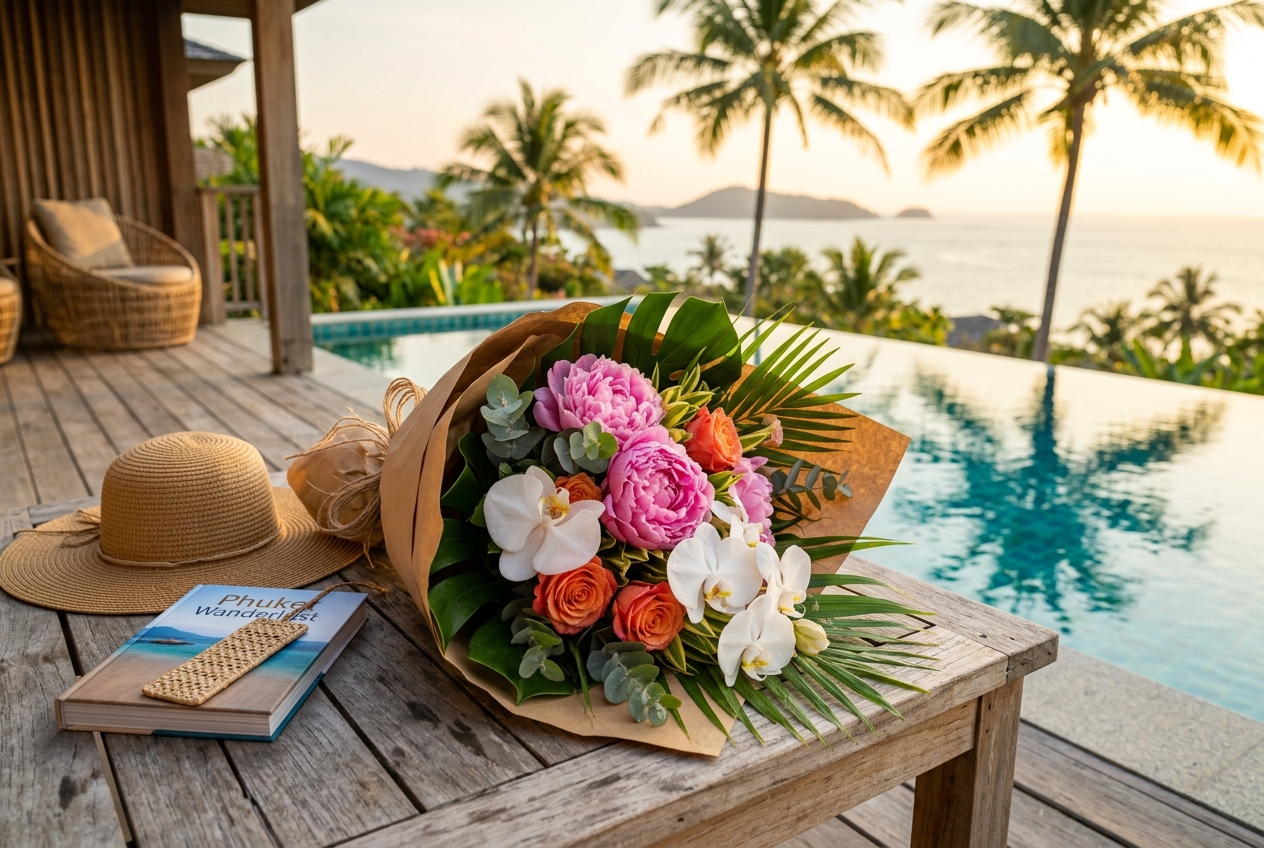
A Wedding in Phuket: How to Combine Thai Floral Aesthetics with the European Wedding Tradition
In short: Phuket is where two flower cultures meet that agree on almost nothing. The European one is the bridal bouquet in the hand, the arch, the boutonnière, flowers on the tables and petals underfoot. The Thai one is the phuang malai — garlands that are not put in a vase but worn and given; jasmine strung as closed buds, not open blooms; flowers named so that the name is already a wish: 'dok rak', the love flower, 'ban mai ru roi', the flower that does not know how to wilt. Take only the European and you get a beautiful wedding that could have happened anywhere. Take only the Thai and your European guests miss half the gestures. Below: how the two grammars are joined on one island — what Thai flowers mean and how to weave them into a European running order, which Phuket family customs can be borrowed without ceremony, where on the island which kind of wedding fits and which flowers survive the heat, the season, where the orchids and roses come from, the budget — and how we put it all together as organisers, not only as a flower shop. At the end — fourteen answers to frequent questions.
Bouquets and arrangements delivered across the island — on the flower delivery in Phuket page, prices in US dollars. Across Thailand: Bangkok, Pattaya. If the wedding is at a hotel — flowers to a Phuket hotel.
Two Flower Languages on One Island
European wedding floristry grew out of the garden: rose, peony, hydrangea, ranunculus, eucalyptus. Its unit is the bouquet gathered into the hand and the arrangement in a vessel. Flowers decorate the space and the bride; they are looked at and photographed.
The Thai tradition grew out of a different material and a different gesture. Its unit is the garland: buds are strung on a thread so densely that the result is not a bunch of flowers but a volume, almost a fabric. A garland is not placed — it is put around a neck, hung on a wrist, laid on a tray and handed over. It is the flower as an act: respect, welcome, a wish. And above all, Thai flowers speak. Their names were chosen for meaning, not colour, and Thai guests read a garland like a text.
Phuket is a rare place where the two languages can stand side by side naturally. The island has hosted European weddings for a hundred years, and its florists are as fluent in a bridal bouquet of garden roses as in a jasmine malai. The task is not to pile one on the other but to decide where each language speaks.
Thai Flower Grammar: What the Flowers in a Garland Mean
| Thai name | What it is | Meaning | Where it fits at a wedding |
|---|---|---|---|
| Dok mali (ดอกมะลิ) | jasmine, strung as unopened buds | purity of intention, a mother's love, respect | the body of the garland; the tassels of the bridal bouquet; the water for the hand ceremony |
| Dok rak (ดอกรัก) | crown flower, white-lilac stars with firm petals | 'rak' is Thai for love; loyalty, durability | the 'clasps' and patterns of the garland: they hold their shape all day |
| Ban mai ru roi (บานไม่รู้โรย) | globe amaranth, round purple heads | 'the flower that does not know how to wilt' — a love that does not fade | garlands for the couple, gift malai for guests: they keep their colour even dried |
| Dao rueang (ดาวเรือง) | marigold, orange and yellow | 'dao' is star, 'rueang' is shining: prosperity, good fortune | hanging strings at the arch and the entrance; the procession trays |
| Dok kluai mai (ดอกกล้วยไม้) | orchids: Dendrobium, Vanda, Mokara | the symbol of Thailand; grace | tables, arch, petals, the bride's sash |
| Dok champa (ดอกจำปา) | champaca, cream-yellow, strongly scented | a scent that 'leads' — meeting, welcome | welcome garlands for guests at the entrance |
Out of this table grows the main garland of the wedding — the malai song chai, a garland with two ends placed around the necks of the bride and groom. It is made of jasmine with patterns of dok rak and ban mai ru roi — literally 'a love that holds its shape and does not fade'. European guests see a beautiful object; Thai guests read a wish.
The European Tradition: What Stays and What Is Rethought
The bridal bouquet stays, but changes its contents. The arch stays, but stops being only roses. The groom's boutonnière stays, with one Thai touch. Petals underfoot stay, but become orchid petals. Tall glass vases with high arrangements on open-air tables, however, almost always lose on the island: the sea wind at 17:00 rocks them, and the heat finishes the roses within two hours. Their place is taken by low runners of orchids and greenery that lie on the table and fear neither wind nor heat.
The main difference, though, is in the gestures. At a European wedding flowers are passive: carried, placed, thrown. At a Thai one flowers are handed over. Add two or three moments to the running order where flowers pass from hand to hand, and the wedding stops being 'a European wedding against a Thai backdrop' and becomes a wedding of the island.
Five Ways to Join Them: From the Bouquet to the Petals
1. The bridal bouquet: garden roses and peonies with jasmine tassels. The base is European: garden roses, ranunculus, lisianthus, greenery. But downwards, as on a Thai garland, hang two or three strings of jasmine buds — the 'uba', the tassels of a malai. The buds open towards evening and begin to smell exactly during the ceremony — that is Thai timing.
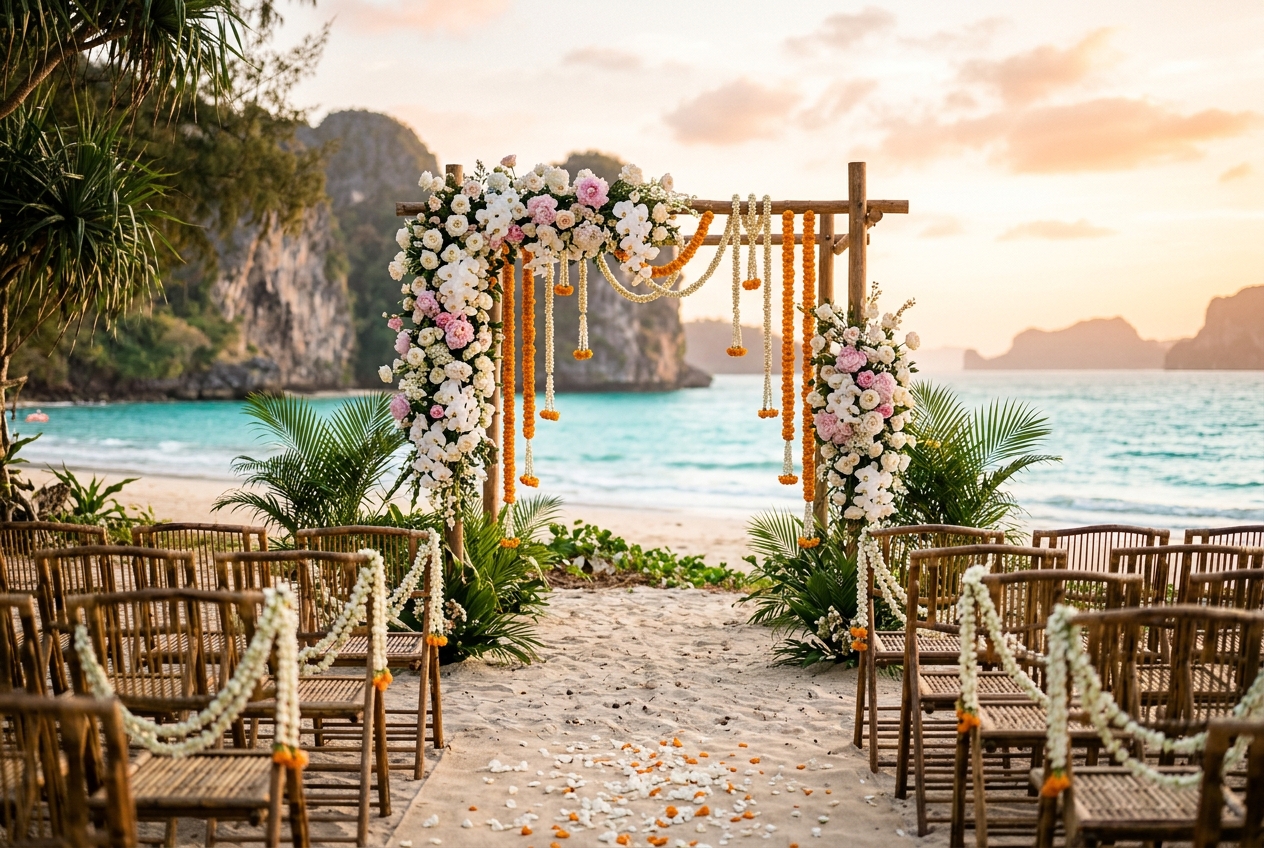
2. The arch: a European top and Thai strings. On the frame — a lush asymmetric corner of white roses, hydrangeas and cascading Dendrobium, and from the crossbar — hanging strings of marigolds and jasmine a metre long. The wind moves them — and that works for the picture, not against it.
3. An exchange of garlands after the exchange of rings. A short moment: after the rings, parents or children place the malai song chai on the couple. It takes a minute, needs no explanation and gives Thai and European guests a shared gesture. After the wedding the garland is dried — ban mai ru roi keeps its colour for years, and it is the one wedding flower you can take home.
4. Tables: orchid runners instead of vases. Dendrobium, Mokara, anthurium, monstera and eucalyptus lie along the table, with low candles in glass between them. Orchids hold 35 °C without water for hours; roses do not.
5. Petals: orchids and jasmine instead of roses. Orchid petals are firm, do not wilt on sand and do not stick to feet; a handful of jasmine buds is added — and the aisle starts to smell as people walk it. The Phuket Town procession showers its newly-weds in exactly this way.
Two Phuket Family Customs Borrowed Without Ceremony
Khan maak — the procession with trays. The groom's family walks to the bride with trays covered in banana leaves and flowers: gifts for the families, fruit, sweets, garlands. In Phuket the procession is often led along the villa or from the beach to the pavilion to Thai drums. For a European wedding it is a ready-made 'first appearance' of the groom — instead of waiting at the arch. The trays are built by florists: marigolds, orchids, folded banana leaves, garlands on top.
The water ceremony — rod nam sang. Senior relatives take turns pouring water from a shell over the couple's joined hands and say a short wish. In the water are rose petals and jasmine buds; the hands rest on a cushion, with garlands beside them. It is the quietest part of a Thai wedding, with no words from a stage, and it sits well where a European running order would have 'wishes from the parents'. It lasts ten to fifteen minutes; from the florist you need a bowl with petals, two garlands and a cushion in orchids.
Both customs are family ones, conducted by relatives; they need no additional participants or preparation. If there are no guests from Thailand, couples keep one — most often the water: it needs no translation.
The Peranakan Wedding of Phuket Town: Where the Island's Own Wedding Aesthetic Comes From
Phuket has something the other beaches of Thailand do not: a wedding tradition of its own, grown in the Old Town. In the nineteenth century the island lived on tin, and Chinese miners married local women; their descendants — the Baba Peranakans — built the Sino-Portuguese houses with arcades on Thalang Road and Dibuk Road and joined Chinese, Thai and European customs in a single wedding dress. Every year in late May or June the Thai Peranakan Association holds the Phuket Baba Wedding: couples from across the island and from abroad marry by these rules at the same time, and then a procession goes down Thalang Road — with a brass band, decorated cars and a rain of petals.
What in this aesthetic is useful for any wedding on the island: the bride in a lace kebaya or a long 'baju panjang', with a gold crown of tiny flowers on springs that tremble at every step; the groom in a white European suit or a silk 'baju lokchuan'; the flowers — jasmine in the hair, marigolds and orchids on the cars; the backdrop — the pastel facades of the shophouses. Hence three ideas that couples with no Peranakan ties borrow too: a morning photo session on Thalang Road before the shops open, a 'trembling' flower hairpin instead of a tiara, and a rain of orchid petals on the way out.
Where on the Island: Villas, Capes, the Old Town, the Bay
| Place | What kind of wedding | Flowers that work | What to watch |
|---|---|---|---|
| Surin, Kamala, Pansea | villas and resorts on the cliffs of the west coast, sunset into the sea | garden roses and hydrangeas in the shade of a pavilion; orchids on open tables | wind at 17:00 — no tall vases outside the pavilion |
| Bang Tao, Laguna | large resorts by the lagoon, weddings of 80–150 guests | long orchid runners, arches with marigolds | lawn pavilions — peonies are possible |
| Mai Khao | a long quiet beach in the north, resorts among casuarinas | cascading Dendrobium, white roses, tropical greenery | aircraft over the beach — mornings are quieter |
| Nai Harn and Promthep Cape | intimate weddings of 10–30 on a hill above the sea | only firm flowers: orchids, anthurium, protea | the strongest wind on the island — garlands, not arrangements |
| Cape Panwa and Cape Yamu | the east coast, villas above the bay, morning light | roses and peonies last longer: shade after 14:00 | boats to Phang Nga leave from here |
| The Old Town | Sino-Portuguese shophouses, photo sessions, dinners in courtyards | jasmine, marigolds, orchids — the Peranakan palette | before 9:00 — empty streets, soft light |
| Phang Nga Bay and Koh Yao Noi | a ceremony on a long-tail boat or an island among the cliffs | garlands on the bow, orchid petals | salt and spray — no roses without water |
Season, Heat and the Timing of the Ceremony
The dry season runs from November to April: clear sunsets, calm water, moderate wind, flowers last longer. May to October is the monsoon: showers are short, but every open-air ceremony needs a pavilion or villa 'just in case'. The peak is December–February, when the villa and the florist are booked six months ahead; April is the hottest, 34–36 °C.
The sun sets in Phuket at about 18:30 all year round. The ceremony is set for 16:30–17:00: the light is already soft, the heat eases, and an hour remains for photographs before sunset. For the flowers this means: the bridal bouquet is made at 13:00–14:00 and kept cold until 16:00; the arch is built from 14:00 in the shade, with the cascades opened last; the orchids go on the tables an hour before dinner; the jasmine is strung on the morning of the wedding — by evening it opens.
The heat dictates the contents. Orchids, anthurium, protea, monstera, palm leaf, globe amaranth and marigolds last the day without water. Roses live 4–6 hours in the shade and 2–3 in the sun: in the bouquet they sit in water capsules, on the tables only in vessels. Peonies and hydrangeas are flowers of the pavilion and the villa: in an air-conditioned room they will see out the dinner; on the beach they will not.
Where the Island's Flowers Come From
Orchids come from Thailand itself: the farms of Ratchaburi and Nakhon Pathom outside Bangkok grow the Dendrobium and Mokara exported all over the world; they reach Phuket by overnight refrigerated truck or the morning flight and are in the workshop by noon. Jasmine, dok rak, globe amaranth and marigolds are picked on the island and on the mainland in Phang Nga — they are strung on the day of the event. Roses for the European part have two sources: the highland plantations of Chiang Mai and Chiang Rai in the north of the country, and the Netherlands and Kenya via the Bangkok auction; Dutch roses cost more but are larger and more predictable in shade. Peonies are imported and strictly seasonal: November–January from the southern hemisphere, May–June from Europe; out of season they are replaced with garden roses. Hydrangeas come from the Chiang Mai highlands, where they are grown for the Bangkok wedding market.
From this follows a simple budget rule: the Thai part of a wedding — garlands, orchids, marigolds, petals — costs noticeably less than the European part for the same visual volume. So couples who want 'a lot of flowers' shift the weight towards the Thai side and keep roses and peonies for the bridal bouquet and the near zone of the ceremony.
Budget: What the Floral Part Is Made Of
| Item | What is included | Guide, $ |
|---|---|---|
| Bridal bouquet | garden roses, peonies or ranunculus, jasmine tassels, water capsules | 150–400 |
| Boutonnières for the groom and guests | a rose or orchid, a jasmine bud, ribbon | 12–25 each |
| Malai song chai for the couple | jasmine, dok rak, globe amaranth, handmade | 90–180 |
| Welcome garlands for guests | jasmine and orchids, for the wrist | 8–15 each |
| Arch | frame, European corner, hanging strings of marigolds and jasmine | 900–2,500 |
| Khan maak procession trays | 6–12 trays, banana leaves, flowers, garlands | 400–900 |
| Bowl and cushion for the water ceremony | petals, buds, orchids, two garlands | 120–250 |
| Tables | orchid and greenery runners for 8–10 guests | 120–220 per table |
| Petals | orchids and jasmine for the aisle and the exit | 80–200 |
An intimate wedding of 20 guests at a villa comes to $2,500–4,500 in flowers; a wedding of 80–100 guests at a resort with an arch, a procession and tables — $7,000–15,000. The most expensive lines are imported roses and peonies; the best value for impression are orchids and garlands.
How We Put a Phuket Wedding Together — as Organisers, Not Only Florists
YUCCA Flowers in Phuket is not only a catalogue of bouquets. For a wedding we work as the floral organiser: we build the concept from your references and the Thai palette, suggest a venue for your size and season or work with the one you have chosen, agree set-up times and power with the villa or resort, bring and build the arch, the tables and the procession, string the garlands on the morning of the wedding, meet the bride with her bouquet at 16:00 and clear everything afterwards. Your manager is one person, in English or Russian, on WhatsApp, from the first message to the last photo.
Payment is by a card from any country in dollars or euros, Apple/Google Pay, bank transfer or crypto; a deposit when the concept is confirmed, the balance a week before. We send a photo of every item — bouquet, arch, garlands — before set-up; if something is not right, we change it on the spot. For guests and couples who simply want to congratulate: bouquets from the catalogue are delivered to any hotel or villa on the island the same day.

White Étude

Peony Silk

Dark Orchid

Cloud of Tenderness

101 Roses

Hydrangea Queen
| Bouquet | What's inside | Price | When it fits |
|---|---|---|---|
| 'White Étude' | white roses with greenery, compact | $99 | congratulations to a bridesmaid, a welcome for guests at the hotel |
| 'Peony Silk' | garden roses, pastel | $286 | a bridal bouquet for an intimate ceremony |
| 'Dark Orchid' | orchids with dark roses | $314 | an arrangement for the couple's table |
| 'Cloud of Tenderness' | a large pastel bouquet | $425 | a gift to the couple from the parents, to the villa |
| '101 Roses' | one hundred and one roses | $897 | the bride's morning, a proposal at Promthep |
| 'Hydrangea Queen' | hydrangeas and roses, a premium arrangement | $1017 | the wedding table in the pavilion |
Frequently Asked Questions About Wedding Flowers in Phuket
What is a phuang malai and why is it at a wedding? A Thai garland of buds strung on a thread. At a wedding the couple wear the malai song chai — a two-ended garland of jasmine with patterns of dok rak and globe amaranth; guests receive small garlands for the wrist.
What do the names of Thai wedding flowers mean? Dok rak — 'the love flower'; ban mai ru roi — 'the flower that does not know how to wilt'; dao rueang — 'shining star', good fortune; dok mali, jasmine — purity of intention and respect. Thai guests read a garland as a wish.
Can a European bridal bouquet be combined with Thai flowers? Yes: a base of garden roses and ranunculus, and downwards two or three tassels of jasmine buds, as on a garland. The buds open towards evening and smell during the ceremony.
Which flowers survive the heat on the beach? Orchids — Dendrobium, Mokara, Vanda — anthurium, protea, globe amaranth, marigolds, tropical greenery. Roses only in water capsules and in the shade; peonies and hydrangeas in a pavilion or a room.
When is the best season for a wedding in Phuket? November to April: dry, clear sunsets, moderate wind. The peak is December–February; villas and florists are booked six months ahead. May to October is the monsoon; you need a pavilion 'just in case'.
What time should the ceremony start? At 16:30–17:00: the sun sets at about 18:30 all year, the light is already soft, and an hour remains for photographs before sunset.
What is the Phuket Baba Wedding? The annual Peranakan wedding of Phuket Town in late May or June: couples marry by Baba custom and then walk in procession down Thalang Road to a band and a rain of petals. Brides wear a kebaya with a gold crown of trembling flowers.
What is the khan maak procession and can it be done at a villa? The groom's family walks to the bride with trays in banana leaves and flowers. At a villa it is led from the beach or the gate to the pavilion — a ready-made 'first appearance' of the groom.
What is the water ceremony and is it needed if there are no guests from Thailand? Elders pour water with rose petals and jasmine over the couple's hands and say a wish. It needs no translation and takes 10–15 minutes; of the two Thai customs, couples most often keep this one.
Where do Phuket's orchids and roses come from? Orchids from the farms of Ratchaburi and Nakhon Pathom outside Bangkok, by overnight refrigerated truck; roses from the plantations of Chiang Mai and Chiang Rai or from the Netherlands and Kenya via Bangkok; hydrangeas from the Chiang Mai highlands.
How much do wedding flowers cost in Phuket? A bridal bouquet $150–400, an arch $900–2,500, tables $120–220 each, the couple's garland $90–180. An intimate wedding $2,500–4,500 in flowers; 80–100 guests $7,000–15,000.
Where on the island for an intimate wedding, and where for a large one? Intimate — Nai Harn, Promthep Cape, the villas of Cape Panwa and Cape Yamu, a long-tail boat in Phang Nga Bay. Large — the resorts of Bang Tao and Laguna, Mai Khao, Surin and Kamala with pavilions.
Do we need to register the marriage in Thailand? The ceremony on the island is the celebration; legal registration is a separate procedure at the district office with papers from your consulate. Many couples register at home and hold the wedding in Phuket.
Do you organise the whole wedding or only the flowers? The floral part in full: concept, a venue for your size and season or work with yours, liaison with the villa, set-up, garlands on the day, the bridal bouquet, take-down. One manager in English or Russian, payment from any country.
Where Next
- A bouquet for the bride, the couple or the guests at any hotel or villa on the island — flower delivery in Phuket: from $89, prices in US dollars, photo before hand-over.
- A wedding or a surprise in another Thai city — Bangkok, Pattaya.
- Flowers to a room on the island — how a bouquet is delivered to a Phuket hotel.
- To discuss a concept, a venue and a date — message us on WhatsApp, we answer in English and Russian.
See also: flower delivery in Phuket, Bangkok, Pattaya, flowers to a Phuket hotel.
READER EXCLUSIVE
5% off your first order
Because you came from our blog, enjoy 5% off your first order. Just mention promo code BLOG5 to the florist on WhatsApp.
Popular bouquets in Phuket
Same-day delivery · photo before sending