Belgrade's Flower Square (Cvetni trg): The Story of the Place Where Flowers Became Part of City Life
In short: Cvetni trg — 'Flower Square' — is a small pedestrian plateau in Belgrade's Vračar district between Kralja Milana, Njegoševa and Svetozara Markovića streets. Its name is not poetic but literal: from 1884 a market worked here to relieve the overcrowded Velika pijaca, and flower shops held the square until the early 2000s. Over a century and a half the place has lived through an 1889 pavilion, Belgrade's first supermarket in 1958, a disputed 2015 reconstruction in white concrete, a 2021 fountain and a monument to the writer Borislav Pekić — all under an oak more than two hundred years old. Below: the square's history by date, a map of where flowers live in Belgrade today (Kalenić, Bajlonijeva, Krnjača, the Jevremovac botanical garden, Manjež park), the flower habits of Belgraders and how all of it connects to ordering a bouquet to Belgrade from another country. At the end — twelve answers to the questions people ask most often about the square and flowers in the city.
Bouquets delivered across Belgrade — on the flower delivery in Belgrade page, prices in US dollars. Other popular cities on the site: Dubai, Istanbul, Barcelona, Antalya, Nice.
What Cvetni trg Is and Why the Square Is Called Flower Square
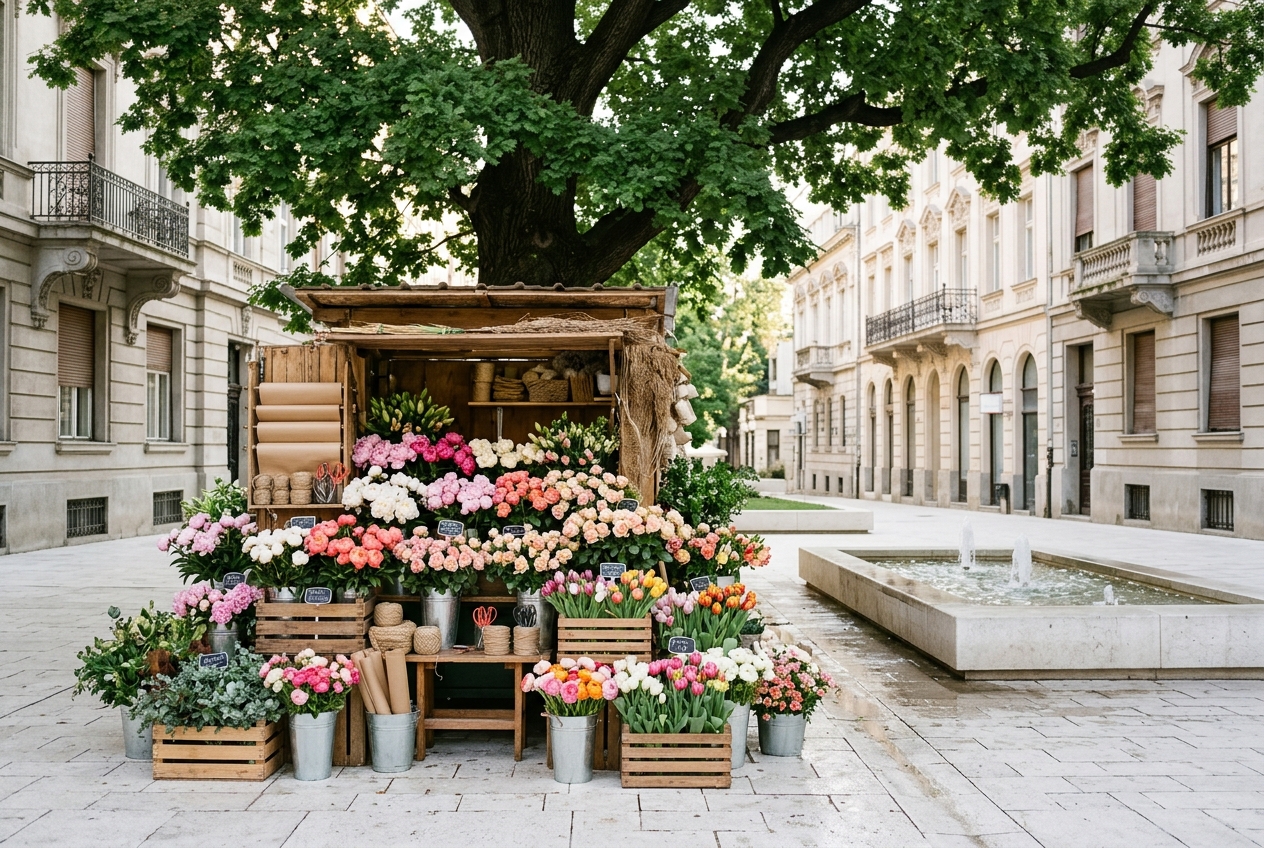
Ask a Belgrader where Cvetni trg is and they will point to a patch behind the National Assembly: up Kralja Milana, before you reach Slavija, turn right — and you are on a white stone plateau with steps, a fountain, a few cafés and an enormous oak. The square is tiny — you can cross it in a minute. But it has one of the most recognisable names in the city, and that name is not a metaphor.
In nineteenth-century Belgrade markets were named after what they sold or where they stood. The Velika pijaca on today's Studentski trg was the main one and overcrowded. When a new market opened in 1884 on the empty lot between Njegoševa and Kralja Milana, flowers and seedlings quickly became its face: Vračar was filling up with villas and apartment houses, and the new households needed geraniums for the balcony, roses for the garden and a bouquet for the table. So the place got a name that outlived both the market and the shops: Cvetni trg — Flower Square.
1843–1884: An Oak Grove, a Commission's Decision and a Market to Relieve the City
Until the mid-nineteenth century this was the edge of town — an oak grove on Vračar hill, outside the city that then huddled around the fortress. In 1843 the city commission that was laying out new blocks set this plot aside for a market: Belgrade was growing fast and trade was crammed into one place. The decision was not carried out at once — only in 1884 did the market formally open, to relieve the Velika pijaca and give the residents of new Vračar their own trading ground.
One oak from that grove is still there. It is estimated to be more than two hundred years old; since 2001 it has been a protected natural monument, and every reconstruction of the square has been designed around it. It is a rare case of a tree older than the streets that surround it.
1889: Grgur Milenković's Pavilion and the Flower Shops
Five years after the opening, in 1889, a covered market building went up on the square to a design by the architect Grgur Milenković — one of the first Serbian architects with a formal degree. The pavilion was functional, without flourishes, but for Belgrade of those years it was the mark of a serious city market: trade under a roof, order, permanent stalls.
It was around the pavilion that the flower sellers settled. Cut flowers came from the suburbs and the gardens of Banjica and Krnjača; in spring they sold seedlings and bulbs, in summer peonies and roses, in autumn chrysanthemums. For the houses of Vračar the square became the place you went 'for flowers' as naturally as you went to Kalenić for cheese and kajmak.
The Twentieth Century: The City Decorates the Square and Opens Its First Supermarket in 1958
As early as the 1930s the municipality was deliberately improving Cvetni trg — planting flower beds, changing the paving, putting in benches: the square was seen as the showcase of new Vračar. The market kept working all the while.
The turning point came in 1958. The old market building was rebuilt, and in it opened Belgrade's first modern self-service supermarket — an event the newspapers wrote about and people came to see as a sight. Stall trade left, but the flower shops stayed around the perimeter and held on for almost another half-century — until the early 2000s, when the last of them closed. By then nobody had any intention of changing the square's name.
2015–2021: White Concrete, a Fountain and a Writer on the Steps
In the 2010s the city decided to turn the worn plateau into a pedestrian zone. The reconstruction was completed on 16 December 2015 and became one of the most debated in Belgrade: pale concrete, minimalism, steps instead of the familiar flower beds. Some called the new square 'sterile', others — modern at last. The argument was less about aesthetics than about memory: the city was used to Cvetni trg meaning greenery and shops.
Two additions answered the criticism. On 2 March 2016 a monument to Borislav Pekić was unveiled on the steps — a writer and academician, one of the most important Serbian authors of the twentieth century, who lived and worked in Vračar for many years. The bronze Pekić sits on the steps and writes — not on a pedestal but among passers-by, so that you can sit down next to him. And in 2021 a fountain designed by Željko Milović started running — low, with a soft sound of water, which gave the square back the feeling of a place where you want to linger.
Where Flowers Live in Belgrade Today
There are no shops on the square itself any more, but the city's flower life has not gone anywhere — it moved to the markets and gardens. If you want to see how Belgraders buy flowers, here is the map.
| Place | District | What it is | Why it matters for flowers |
|---|---|---|---|
| Kalenić market | Vračar, 10 minutes' walk from Cvetni trg | The main city market, founded in 1926 on the former threshing floor of the Kalenić family | The flower row at the Maksima Gorkog entrance: roses by the stem and by the ten, peonies in May, chrysanthemums in autumn; queues before 8 March |
| Bajlonijeva market | Dorćol, by Skadarlija | A market named after the industrialist Ignjat Bajloni | Small flower stalls, seedlings and house plants in spring |
| Krnjača flower market | Left bank of the Danube, past the Pančevo bridge | The wholesale flower market | Florists from all over the city drive here from four in the morning; the widest choice and the lowest prices |
| Jevremovac Botanical Garden | Palilula, Takovska street | The University of Belgrade's garden, founded in 1874 by the botanist Josif Pančić, on its present site since 1889 | A historic glasshouse, a Japanese garden, the oldest trees in the city; a bulb collection in spring |
| Manjež park | Between Kralja Milana and Resavska, two steps from the square | A city park, home of the Belgrade Flower Festival in 2010–2015 | Several times a year — the flower exhibition and fair of the Serbian Flower Growers' Association: seedlings, cacti, ceramics |
| Cvetni trg | Vračar | A pedestrian square | The protected oak, the fountain, the Pekić monument; flower shops on neighbouring Njegoševa and Kralja Milana |
A route for one morning: Cvetni trg — Kalenić — coffee on Njegoševa — Manjež. In two hours you will see how flowers in Belgrade are sold, given and grown.
Belgraders' Flower Habits: What People Give Here and What They Don't
- Odd numbers. As in all Slavic countries, the living are given an odd number of flowers; an even number is only for funerals. One, three, five, seven are the norm — which is exactly why markets sell roses by the stem.
- 8 March is the biggest day of the year. In Serbia Women's Day is taken seriously: flowers go to mothers, colleagues, teachers, neighbours. Roses are sold by the ten at the markets, prices rise one-and-a-half to two times for the week, florists work through the night. Order 2–3 days ahead.
- Valentine's Day is celebrated more quietly than in the West, but red roses run out by lunchtime on 14 February.
- Peonies in May and June are a seasonal cult: for three weeks Belgrade's markets turn pink and white.
- Geraniums (muškatle) and greenery on the balcony are part of the streetscape of old Vračar and Dorćol; buying seedlings in spring is as obligatory as buying summer shoes.
- Flowers 'just because' are the norm. Turning up at friends' with three peonies from Kalenić is more natural here than arriving with a box of chocolates.
How the Square's History Connects to Flower Delivery in Belgrade Today
Cvetni trg is a vivid answer to why ordering flowers in Belgrade is so easy: for 140 years the city has been used to a bouquet being part of everyday life, not a festive rarity. For anyone ordering a bouquet to Belgrade from another country that means three things. First, there is a strong florist school here and a year-round wholesale market in Krnjača — roses, peonies, tulips and orchids are available in any season. Second, the recipient will take the bouquet as a normal, warm gesture, not as 'too much'. Third, the city is compact: Cvetni trg to New Belgrade is 15 minutes, to Zemun 25, and same-day delivery is realistic.

White Étude

Pink Waltz

Peony Silk

Sea of Tulips

Floral Avalanche
What people order most often from our Belgrade catalogue and what it costs:
| Bouquet | Price | Occasion |
|---|---|---|
| 'White Étude' ($95) | white roses and lisianthus | a first meeting, a thank-you, 'just because' |
| 'Heart's Secret' ($106) | pink roses with greenery | a birthday for a friend or mother |
| 'Pink Waltz' ($114) | pink roses and spray roses | 8 March, an anniversary |
| 'Peony Silk' ($279) | peonies and garden roses | May–June, a wedding, a proposal |
| 'Sea of Tulips' ($454) | a large tulip arrangement | spring, a corporate greeting |
| 'Floral Avalanche' ($500) | a large premium arrangement | a jubilee, a wedding, an opening |
Payment is by a card from any country in US dollars, Apple/Google Pay, bank transfer or crypto; the recipient pays nothing. We send a photo of the finished bouquet before the courier leaves, and write whatever you like on the card — in Serbian, English or Russian.
Frequently Asked Questions About Flower Square and Flowers in Belgrade
Where is Cvetni trg and how do I get there? In Vračar, between Kralja Milana, Njegoševa and Svetozara Markovića streets. From the National Assembly — a 10-minute walk up Kralja Milana towards Slavija; from Slavija square — 5 minutes down. The nearest stops are the trams and trolleybuses along Kralja Milana.
Why is it called Flower Square if no flowers are sold there? The name came from the 1884 market, where flowers and seedlings were the main goods. Flower shops stayed on the square until the early 2000s; the name remained as a historical one.
When did Flower Square appear? The plot was set aside for a market by a city commission decision in 1843; the market opened in 1884; the covered pavilion by Grgur Milenković was built in 1889.
What is the oak in the middle of the square? A pedunculate oak left from the grove that grew here before Vračar was built up. It is more than two hundred years old; since 2001 it has been a protected natural monument.
Whose monument is on the steps? Borislav Pekić (1930–1992) — writer and academician, author of 'The Golden Fleece' and 'The Time of Miracles', who lived in Vračar. The monument was unveiled on 2 March 2016; Pekić is shown seated and writing.
Why was the 2015 reconstruction criticised? The square was paved in pale concrete and the familiar flower beds were removed — many found it cold. Later the Pekić monument (2016) and Željko Milović's fountain (2021) softened the impression.
Is it true Belgrade's first supermarket was here? Yes: in 1958 the city's first self-service shop opened in the rebuilt market building.
Where can I buy flowers near Cvetni trg? Flower shops on Njegoševa and Kralja Milana; the flower row at Kalenić market 10 minutes' walk away. The lowest prices are at the wholesale market in Krnjača, but that means crossing the Danube.
When is the flower exhibition held in Belgrade? Several times a year in Manjež park — the fairs of the Serbian Flower Growers' Association (spring and autumn); the spring one is the largest. Exact dates are announced a month ahead.
How many flowers is it customary to give in Serbia? An odd number — one, three, five, seven. An even number is only for funerals.
Which day in Belgrade is the biggest for flowers? 8 March. Roses are sold by the ten, florists work through the night, prices rise one-and-a-half to two times. Order 2–3 days ahead for that date.
Can I order a bouquet to Belgrade while in another country? Yes. On the flower delivery in Belgrade page you pick a bouquet, give the address or hotel and the recipient's phone, pay with a card from any country in US dollars — and receive a photo of the bouquet before hand-over. Vračar, Dorćol, New Belgrade and Zemun — same day if confirmed by 14:00.
Where Next
- Order a bouquet to Belgrade — the Belgrade flower delivery catalogue: from $95, prices in US dollars, photo before hand-over.
- Popular cities on the site — Dubai, Istanbul, Barcelona, Antalya, Nice.
- Ordering abroad for the first time — how to order flowers from another country.
- A question about an address in Vračar or a hotel in the centre — message us on WhatsApp, we answer in English and Russian.
See also: flower delivery in Belgrade, Dubai, Istanbul, Barcelona, how to order flowers from another country.
READER EXCLUSIVE
5% off your first order
Because you came from our blog, enjoy 5% off your first order. Just mention promo code BLOG5 to the florist on WhatsApp.
Popular bouquets in Belgrade
Same-day delivery · photo before sending